Agile Unemployment: Normalizing the Way We Talk About Being Out of Work
It shouldn’t be awkward and uncomfortable to talk about being unemployed. Given that sooner or later most of us will experience being out of work, shouldn’t we start to have normal and healthy conversations about being unemployed? Agile Unemployment podcast host, employment expert, and author, Sabina Sulat creates a safe place to talk about all things unemployment. In each episode, Sabina will cover everything you need to know to not only survive, but thrive through being out of work.









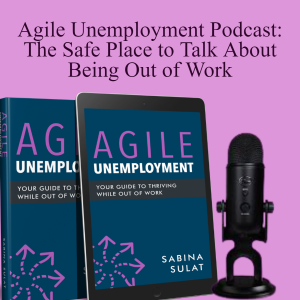
Agile Unemployment Podcast
Based on the book by the same name, the Agile Unemployment Podcast takes a deeper dive into all topics of unemployment. Join host and employment expert Sabina Sulat as she revolutionizes the way we think and talk about being out of work.
Episodes
26 minutes ago
26 minutes ago
42 min
There are seasons when life does not fall apart exactly.
It just gets loud.
Too many open loops. Too many deferred decisions. Too many responsibilities waiting for attention. Too many emails, appointments, projects, rooms, conversations, worries, and future plans quietly asking to be handled.
At some point, the issue is not that you are incapable.
The issue is that you are no longer leading your life.
You are responding to it.
In this episode of Agile Unemployment, Sabina explores the idea of Restoring Command: the process of returning to calm authority over your life when work, health, home, money, relationships, and future plans begin to feel scattered.
This is not about control. Control is often fear dressed up as discipline. It tightens, grasps, and tries to eliminate uncertainty.
Command is different.
Command is the ability to look honestly at the real state of things and say: this is where I am, this is what matters, this is what needs support, and this is the next responsible move.
This episode is for anyone who is still functioning, still showing up, still getting things done — but quietly knows they are reacting more than leading.
Sabina discusses why capable people are especially vulnerable to losing command, how urgency and open loops drain agency, why shame is a terrible strategy, and why rest is sometimes the first act of leadership.
She also connects Restoring Command to career transition and unemployment, where the loss of work can disrupt not only income, but identity, structure, confidence, health, relationships, and future plans.
Because getting back to work is not only about activity.
It is about traction.
And traction begins when you restore enough command to choose the next responsible move.
In This Episode
Sabina explores:
The difference between control and command
Why functioning is not the same as leading
How capable people can become trapped by their own capacity
Why urgency is not always importance
The emotional cost of open loops
How shame weakens agency instead of restoring it
Why rest can be a command decision
What restoring command looks like during unemployment or career transition
How to move from activity to traction
Why the next responsible move matters more than the perfect plan
Pull Quotes
“Functioning means you are still moving. Command means you are leading.”
“Control is often fear dressed up as discipline. Command is calm authority.”
“Shame is not a strategy.”
“Rest is not quitting. Rest is returning to capacity.”
“Activity burns energy. Traction restores agency.”
“You do not have to fix everything today. You do have to return to yourself.”
“Command is not the absence of uncertainty. Command is the ability to lead yourself inside uncertainty.”
Listener Reflection Questions
Where am I functioning, but not leading?
What open loop is taking up more energy than it deserves?
What am I avoiding because it feels too big, too late, or too emotionally expensive?
Where has urgency been making decisions for me?
What would restore even a small amount of command this week?
What is the next responsible move?
Suggested Episode Description
When life gets loud, it is easy to confuse functioning with command. You may still be answering emails, showing up to meetings, caring for others, applying for jobs, managing the house, and keeping things moving — while quietly knowing that you are reacting more than leading.
In this episode, Sabina Sulat explores what it means to restore command: not control, not perfection, and not panic disguised as productivity, but calm authority over your attention, energy, standards, and next moves.
This episode is about open loops, urgency, shame, rest, career transition, unemployment, and the power of choosing the next responsible move.
Jun 30, 2026
Jun 30, 2026
28 min
Regaining Traction Without Blaming Yourself: From Shame to Agency
There is a difference between failing and being overwhelmed.
There is a difference between self-sabotage and survival.
And there is a difference between losing traction and losing your future.
In this episode, Sabina talks about what happens when someone is operating under prolonged threat while still trying to build a future.
A hard chapter does not just affect your circumstances. Over time, it can affect how you interpret yourself.
At first, you may be able to say:
“I lost my job.”“I am dealing with a financial issue.”“I am burned out.”“I am in transition.”
But when stress continues, the language often changes.
“What is wrong with me?”“Why can’t I fix this?”“Why am I so far behind?”“Why am I frozen?”“Why can everyone else manage their lives and I cannot?”
That is where shame takes over.
Shame takes a situation and turns it into an identity. A hard chapter becomes a failed life. A delay becomes proof that you are irresponsible. A period of freezing becomes evidence that you are broken.
But many people are not broken.
They are overloaded.
They may be trying to solve complicated problems while sleep-deprived, scared, isolated, financially strained, emotionally exhausted, and unsure of who or what to trust.
This episode explores why people do not do their best long-term strategic thinking while they feel under threat—and why that word, feel, matters.
The future gets harder to imagine. Small tasks feel enormous. Decisions feel dangerous. Phone calls feel impossible. Opening mail can feel threatening. Answering messages can feel like climbing a mountain.
Then the spiral begins: a person cannot operate at their usual capacity, judges themselves for that loss of capacity, and carries shame on top of the stress that caused it.
Sabina offers a practical framework for rebuilding agency:
Containment
What must be stabilized first?
Containment is not solving everything. It is addressing the issue that is most urgent, most destabilizing, or most within reach. It may be opening one piece of mail, making one appointment, getting one night of sleep, calling one person, or resolving the problem that is screaming the loudest.
You cannot fix everything at once. But you can decide what comes first.
Sequencing
What comes next—and what has to wait?
Sequencing restores order when everything feels urgent.
First facts. Then options. Then decisions. Then action.
Or:
First stabilize. Then prioritize. Then move.
Not every important thing is first. Sometimes the most powerful thing a person can hear is, “Not today.” Not because it does not matter, but because it is not first.
Support
Who needs to be in this with me?
Support is not weakness. It is infrastructure.
The more complex the situation, the more support matters—not because you are incapable, but because complexity requires structure.
Support may be an attorney, therapist, doctor, financial advisor, coach, mentor, friend, colleague, family member, community, or someone who can simply sit beside you while you make the call.
Agency does not usually return through shame.
It returns through clarity, structure, information, support, and the next doable action.
This episode is for anyone who has been carrying too much for too long—and for the people, employers, educators, leaders, and communities who want to understand what support can look like before someone reaches a breaking point.
A hard chapter is not the whole book.
You may have lost traction.
That is not the same thing as losing your future.
In This Episode
Why prolonged stress changes how we see ourselves
How shame turns circumstances into identity
Why cumulative pressure can be as destabilizing as a single crisis
Why people under threat may avoid, freeze, delay, or struggle to advocate for themselves
The difference between responsibility and blame
How containment, sequencing, and support help rebuild agency
Why support is infrastructure, not weakness
How to create a future that is both beautiful and structurally possible
Key Quotes
“Shame takes a situation and turns it into an identity.”
“You stop seeing a crisis that needs containment, sequencing, and support. You see yourself as the crisis.”
“You cannot fix everything at once. But you can decide what comes first.”
“Not every important thing is first.”
“Support is not weakness. It is infrastructure.”
“The more complex the situation, the more support matters—not because you are incapable, but because complexity requires structure.”
“Agency does not usually return through shame. Agency returns through clarity, structure, information, support, and the next doable action.”
“You may have lost traction. That is not the same thing as losing your future.”
Reflection Questions
What in my life feels most urgent right now?
What actually needs containment first?
What information do I need before I make a decision?
What is important but not for today?
Who needs to be in this with me?
What is one next doable action that would create even a little more stability?
Jun 10, 2026
Jun 10, 2026
27 min
Episode Description
In this episode of Agile Unemployment, Sabina Sulat examines the workplace term “insubordination” and why it often operates less like a clear behavior and more like a subjective label. Prompted by recent public commentary around Scott Pelley’s departure from CBS (while acknowledging we don’t know what happened inside the room), Sabina explores how “insubordination” can be used to control narratives in organizations that claim to value ethics and a speak-up culture. We unpack the speak-up paradox, the link between insubordination and psychological safety, the culture damage caused by misuse of the label, and practical options for speaking up with strategy and agency—plus how to talk about it in interviews if you’ve been tagged with the word.
What We Cover
Why this topic is back in the public conversation (and what we can and can’t know)
“Insubordination” on paper vs. how it’s used in real workplaces
The 3 things people confuse: principled dissent, interpersonal breakdown, and power/control
Psychological safety and the role of standing up for others
The “speak up” paradox: encouraged to speak until you do
What kind of culture forms when “insubordination” becomes a catch-all label
How misuse drives toxicity, fear, low insight, and low creativity
Why the threat of “insubordination” often signals a failure of management and coaching
What to do: options for speaking up with strategy (channel, framing, documentation, allies)
When leaving is the most adult expression of agency
Interviewing after a conflict: a clean narrative structure you can use
Key Takeaways
Insubordination is often less about what was said than what it threatened.
A true speak-up culture requires governance, not slogans.
Psychological safety isn’t comfort; it’s the ability to raise truth without retaliation.
You can be principled and strategic: choose channel, frame in outcomes, document cleanly.
If a culture punishes truth, you have options—and exiting isn’t failure.
Practical Framework: “How to Speak Up Without Self-Sabotage”
Try these options depending on your environment:
Clarify the directive and success metric
Separate facts, impact, recommendation, and what you need
Choose the smallest effective audience first
Document for clarity (not paranoia)
Anchor to values and risk (fairness, compliance, customer impact)
Build allies/sponsorship when the culture is political
Know your line (preference vs integrity)
Know when the cost is too high and plan a dignified exit
Quote Pulls for Social
“Discomfort gets mislabeled as misconduct.”
“If you punish truth, you get silence. Silence becomes surprise. Surprise becomes crisis.”
“Psychological safety isn’t comfort. It’s truth without retaliation.”
“A label is not a verdict. Learn the system, then choose your move.”
“Leaving isn’t failure. Sometimes leaving is agency.”
Related Listening
Sabina references the work of Jocelyn Davis and her book Insubordinate and encourages listeners to revisit prior episodes featuring Jocelyn for another lens on the fine line between being “insubordinate” and being principled.
Hashtags / Tags
#AgileUnemployment #WorkLiteracy #Agency #SpeakUpCulture #Leadership #PsychologicalSafety #CareerTransitions
May 20, 2026
May 20, 2026
27 min
Rethinking Ready: What the Class of 2026 Needs to Know to Read the System They're Entering
Agile Unemployment Podcast | Sabina Sulat
Every May, new graduates get handed the same story: the market is brutal, the odds are against you, good luck.
That is not this episode.
The Class of 2026 doesn't have a job market problem. They have a Work Literacy problem. And those are not the same thing — and the difference is everything.
In this episode, Sabina Sulat breaks down what's actually happening in entry-level hiring, why new graduates are struggling in ways that have nothing to do with the market, and what they — and the parents, mentors, and career professionals supporting them — need to know before day one.
What You'll Hear in This Episode
[3:30] Work Literacy — the framework What Work Literacy actually is, why every workplace runs two systems simultaneously (the formal and the informal), and why the ability to read both is the skill no one is teaching.
[11:30] The real state of the market Why the "impossible" narrative doesn't match what employers and clients are actually reporting — and how confusing two distinct problems (market vs. preparation) is creating a false crisis.
[19:30] The three markets you're confusing The job market, the hiring market, and the attention market are three different things operating simultaneously. Understanding the difference between them is what separates graduates who get traction from those who personalize what is actually procedural.
[27:30] What entry-level hiring actually rewards The four things hiring managers are really evaluating at entry level — Signal, Slope, Stability, and Support — and why your job is not to be impressive. It's to be legible.
[37:30] What institutions get right — and what they miss Career offices do valuable work. But there's a gap between helping students find jobs and preparing them to navigate work. Here's what falls through.
[45:00] The culture shock of day one The transition from student to employee is a literal culture shock — and almost no one prepares people for it. The center of gravity shifts. The question changes. And if you don't have the map, you'll interpret a systems problem as a personal failure.
[53:00] The parent and school playbook Five specific things educators, advisors, and parents can teach before graduation that would save new graduates years of anxiety and crisis learning.
[62:00] A direct message to the Class of 2026 Five things to do right now: stop interpreting silence as rejection, build a pipeline not a prayer, find your signal tribe, understand what the interview is actually for, and know the informal system before you arrive.
Key Concepts from This Episode
Work Literacy — the ability to read the systems that shape every workplace, including the rules that were never written down, the evaluation criteria that were never shared, and the norms that will be held against you before you have any chance to learn them.
The Three Markets — the job market (supply and demand for labor), the hiring market (how organizations actually execute hiring), and the attention market (how candidates get seen). New graduates conflate all three — and lose confidence when they shouldn't.
Signal, Slope, Stability, Support — the four things entry-level hiring managers are actually evaluating. Knowing this reframes the entire job search.
Agency — what you do with Work Literacy. The moment you stop moving through work by accident and start making informed choices.
Mentioned in This Episode
Generating EEx by Sabina Sulat — coming soon
Agile Unemployment by Sabina Sulat — available now
Connect + Go Deeper
Podcast: Agile Unemployment on Podbean
LinkedIn: Sabina Sulat
Substack: Re:Working
Website: reworking.co
If this episode was useful, share it with a new graduate, a parent, or a career professional who needs the language for this conversation.
#WorkLiteracy #AgileUnemployment #ClassOf2026 #JobSearch #CareerAdvice #EmployeeExperience #NewGrads #GeneratingEEx #Agency #ReWorking
Apr 22, 2026
Apr 22, 2026
37 min
Unemployment often shrinks your world at the exact moment you need visibility, truth, and support. This episode reframes connection as a career and nervous-system necessity, not a social performance. Sabina explains why the turning point for many job seekers is not a new résumé, but a conversation that delivers context and truth. You’ll learn what a real “tribe” does, how to build a signal network, and how to seek the rare balance of empathy and accountability.
Key Concepts Covered
1) The cruel paradox of unemployment
Unemployment isolates you, while job search requires connection
Isolation increases emotional interpretation: silence becomes rejection, delays become verdicts
Connection restores reality and steadiness
2) Network vs tribe vs signal network
A network can be broad and busy
A tribe creates orientation and reduces distortion
A signal network is the group that moves truth, context, and timing through the system
3) The 5 roles your tribe provides
Stabilizer: helps regulate you when you’re spinning
Truth Teller: shares the hard truth with care and respect
Translator: decodes the lane you’re targeting and what actually matters
Connector: moves you from applicant to human through trust
Mirror: reflects what’s real when fear is loud
4) The balance most people can’t find
Support without truth can keep you comfortable but stuck
Truth without support can become cruelty
What job seekers need is the rare middle: support + truth and empathy + accountability
5) Reciprocity and contribution
A tribe isn’t built through extraction
Healthy ecosystems require contribution, consistency, and generosity
Agency includes generosity to self and others
Stories Shared in This Episode
Sabina + Shauna (mentor story)During unemployment, Sabina’s mentor Shauna invited her for a weekend visit that changed her life. On the second morning, Shauna told Sabina she didn’t think she should go back to work and instead should build her own business. Sabina couldn’t receive it at the time, but that kitchen-table truth became a future anchor and a reminder that sometimes the right truth arrives before you’re ready to hear it.
Client dinner party storyA client feeling low wanted a task to regain control. Sabina advised self-care and being with people. The client reluctantly attended a dinner party that led to a conversation, an introduction, and an interview. The point wasn’t the dinner party; it was the ecosystem. Opportunity moves through humans, and connection can regulate your nervous system enough to keep making smart moves.
This Week’s Assignment: Reconvene Your Signal Network
Pick one person (or identify who you need) in each category:
Stabilizer
Truth Teller
Translator
Connector
Mirror
If you don’t have all five, start with one. Reach out not to ask for a job, but to re-enter reality.
Apr 14, 2026
Apr 14, 2026
27 min
Reconnect: Why Connection Is the Real Infrastructure of Unemployment
What We Cover in This Episode
Unemployment doesn’t just disrupt income—it disrupts identity, routine, and community. And the longer it lasts, the more it pushes people inward. The paradox? The way out often requires moving outward—into conversations, relationships, and communities that restore truth, trust, and momentum.
In this episode, we unpack connection as a Work Literacy skill and an agency practice—not a personality trait or a “networking hack.”
Key Ideas
Unemployment is isolating by design, while re-employment often depends on human connection.
Many people say “the market is broken,” when what they really mean is: “I can’t access clarity.”
Clarity rarely comes from job boards or the Apply button. It often comes through people: context, timing, truth.
Connection isn’t only for getting hired. It’s for staying stable while you search.
Agency isn’t pretending you’re okay. Agency is choosing actions that influence outcomes over time—even when you’re tired.
Work Literacy helps you stop personalizing system friction: hiring is risk reduction, volume creates triage, silence is often process—not worth.
The 3 Forms of Connection a Modern Job Search Requires
Connection to selfValues, strengths, skills, boundaries—what you want, what you offer, what you will not trade away.
Connection to workExpectations, incentives, outcomes—how work works and how hiring actually functions.
Connection to peopleTrust, visibility, context—how information and opportunity move through the ecosystem.
Story From This Episode
A client told Sabina, “I’m feeling low. What should I do?” He expected a task—a résumé tweak, an application push—something that felt controllable. Instead, Sabina advised self-care and being with people. He reluctantly went to a dinner party… which led to a real conversation… which led to an interview. Not because dinner parties are magic—but because opportunity moves through humans and connection restores perspective.
Reconnect Challenge (This Week’s Reset)
If you’re unemployed right now, try this for the next 7 days:
Reconnect with one person who knows you well
Reconnect with one person in the lane you’re moving toward
Reconnect with one place that makes you feel like yourself again
(You’re not “networking.” You’re rebuilding infrastructure.)
Quotes to Pull for Social
“Unemployment is isolating by design—while re-employment often requires connection.”
“Connection isn’t a bonus layer. It’s infrastructure.”
“When clarity is scarce, humans become the bridge.”
“Agency isn’t pretending you’re okay. It’s choosing actions that influence outcomes over time.”
“Your network should reflect where you’re headed, not only where you’ve been.”
Listener Prompt
Where are you most disconnected right now—self, work, or people—and what’s one small way you can reconnect this week without overextending?
Tags
#AgileUnemployment #Agency #WorkLiteracy #JobSearch #ReWorking
Apr 2, 2026
Apr 2, 2026
35 min
Welcome to the latest episode of the Agile Unemployment Podcast!
What this episode covers:
Why transparency and empathy are intertwined (empathy isn’t just tone—it’s orientation)
Why “the truth” is the most elusive—and most needed—commodity in job search
How silence fuels anxiety, self-blame, and “résumé theater”
Why hiring teams default to opacity (and why it backfires)
What practical transparency looks like without oversharing
How transparency improves outcomes: trust, conversion, signal, and time-to-fill
What job seekers can do to stay strategic in opaque systems
Key lines from the episode
“Silence is a communication choice. It communicates something—even if it’s not what you intended.”
“Ambiguity is expensive.”
“Transparency doesn’t require perfection. It requires orientation.”
“If you know something that affects a candidate’s next move—say it.”
Employer Transparency Checklist (quick version)
Before you post: define success in outcomes; separate must-haves from wish lists; confirm realistic timelines.During the process: publish steps; share timeline ranges; communicate pauses; close loops.Decision quality: structured interviews; consistent criteria; proof opportunities that match the work.Internal discipline: one owner for comms; weekly funnel checkpoint; track time-in-stage + drop-offs.
For job seekers: protect your agency in opaque systems
Set your own follow-up and “redirect energy” deadlines
Run parallel pipelines (don’t bet your month on one role)
Ask direct questions early about timeline, steps, and ownership
Build trust signals: clarity, proof, pathways
Treat silence as data—not a verdict
Take Back the Narrative Hiring doesn't have to be a gauntlet of uncertainty. By adding structure to the "in-between" moments, we move closer to a more human-centric world of work.
Employers: Audit your funnel. If your process doesn't reflect your values, it's time to redesign the experience.
Job Seekers: Treat your search like the professional operation it is. Use pipeline strategies to stay in the driver’s seat of your own career.
Feb 22, 2026
Feb 22, 2026
36 min
Unemployment is brutally real — but “the market is brutal” is often the wrong diagnosis. In this episode, Sabina separates the market, the hiring system, and your job-search model—then gives you the levers to upgrade.
Episode Summary
LinkedIn is full of competing messages about unemployment: “it’s brutal,” “it’s luck,” “apply more,” “stay positive,” “network.” For long-term job seekers, it can feel like whiplash. In this episode, Sabina (author of Agile Unemployment and founder of Re:Working) breaks down what’s actually happening: a decent market can exist alongside an overwhelmed hiring system, and an outdated job-search model gets punished in a fast, automated environment. You’ll learn why “validation” can’t become surrender, why silence is the most important feedback, and how to upgrade your approach using five practical levers: targeting, positioning, pathways, proof, and interview performance—ending with a 7-day Re: Working reset.
What You’ll Learn
Why “the market is brutal” is often an incomplete (and unhelpful) diagnosis
The difference between the job market, the hiring system, and your job-search model
How high volume + ATS filtering changes what “works”
Why hiring is risk reduction, not talent discovery
How to stop spiraling by tracking your funnel like a system
The 5 levers that consistently change outcomes
Why “no feedback” is the most important feedback—and what to do next
A 7-day reset to rebuild momentum without burning out
Episode Outline + Timestamps
00:00–02:30 | Intro: the whiplash of unemployment advice
“The market is brutal / it’s luck / it’s volume”
Two traps: self-blame vs powerlessness
Thesis: unemployment is brutal; the better diagnosis is system + outdated models
02:30–08:30 | Part 1: Validation without fatalism
Unemployment as a stress event (healthcare, savings math, identity strain)
“Validation is not surrender”
Re:Working stance: empathy with accountability; agency is real
08:30–16:00 | Part 2: Market vs system vs model
Market = environment; System = execution; Model = your behavior
Paradox: decent market + overwhelmed system + outdated model = silence
Work literacy = moving with intelligence instead of hope
16:00–25:00 | Part 3: Why old models fail now
Old model: apply, tweak, wait, repeat
Failure points:
volume creates triage
ATS isn’t neutral
hiring = risk reduction
identity language vs outcome language
“network more” is too vague to execute
25:00–31:00 | Part 4: The upgrade—hope to diagnostics
“The market doesn’t respond to motivation. It responds to method.”
Funnel framing: inputs → process → outputs
What you don’t measure, you interpret emotionally
31:00–43:30 | Part 5: The five levers
Targeting: one primary + one adjacent role; write a “fit thesis”
Positioning: résumé as argument; outcomes in top third
Pathways/Access: stop relying on cold apps; 3 targeted messages/day
Proof: one visible artifact/week; reduce risk
Performance: interviews as risk audits; prepare “risk reducers”
43:30–47:00 | Part 6: The hard truth about 2+ years
“It’s not you; it’s your model.”
Hopeful reframing: if it’s the model, you have levers
Personal note: the turning point is upgrading the system
47:00–50:00 | The 7-Day Re: Working Reset
90 min/day focused work
3 access messages/day
1 proof artifact/week
track funnel
1 recovery ritual/day
50:00–52:00 | Close + CTA
Key takeaways
Share with someone who needs an upgrade, not a pep talk
Reset the checklist in the show notes
#AgileUnemployment #Reworking #WorkLiteracy #WorkAgency
Jan 20, 2026
Jan 20, 2026
55 min
Episode Overview
In the last episode of Agile Unemployment, we focused on what happens after toxic work—and why recovery and restoring agency are essential before returning to a new role.
This conversation shifts the lens to prevention.
Sabina Sulat is joined by organizational development and workplace culture expert Ryan McCrea to explore how toxic work cultures reveal themselves before you accept a job—and why so many candidates miss the signs.
Rather than focusing on obvious “bad boss” stereotypes, this episode looks at culture as a system: how power operates, how accountability is handled, and how organizations respond to questions, boundaries, and uncertainty during the hiring process.
What You’ll Hear in This Episode
Ryan and Sabina unpack why toxic cultures are rarely visible in polished interviews—and how they show up instead through patterns, language, and reactions.
They discuss how candidates can read between the lines when:
answers feel vague or overly rehearsed
questions about feedback, turnover, or decision-making are met with defensiveness
different interviewers tell subtly different stories
“fast-paced,” “family,” or “high-performance” language masks pressure and control
You’ll also hear how to assess culture without putting yourself at risk, why your discomfort during interviews is meaningful data, and how to evaluate opportunities from a place of clarity rather than urgency—especially after toxic work or unemployment.
Why This Conversation Matters
One of the lasting effects of toxic work is loss of agency—the ability to trust your judgment, advocate for yourself, and say no when something doesn’t feel right.
Without intentional discernment, people often accept roles too quickly, explain away early warning signs, and unknowingly repeat the same patterns they worked hard to escape.
This episode helps listeners slow down, sharpen their cultural radar, and protect their agency before saying yes.
Toxic work cultures don’t usually announce themselves.
They reveal themselves in how questions are handled, how power is exercised, and how much truth a system can tolerate.
Learning to recognize those signals before you accept a job is one of the most important career skills you can build.
Jan 13, 2026
Jan 13, 2026
27 min
Episode Overview
Leaving a toxic workplace is often described as a relief—but for many people, it’s when the real impact finally begins.
In this episode of Agile Unemployment, Sabina Sulat explores why people often feel worse after leaving toxic work, how prolonged exposure to unhealthy environments affects self-esteem and agency, and why simply “finding another job” can unintentionally repeat the same cycle.
Drawing from real client patterns, personal experience, and a timely cultural moment, this episode reframes recovery as a critical—and strategic—part of returning to work healthy, confident, and able to advocate for yourself again.
What This Episode Covers
Why toxic workplaces are often hard to recognize while you’re in them
How survival mode during unemployment masks the full impact of toxicity
Why symptoms often surface after safety and stability return
The difference between authority and agency—and how toxic work erodes the latter
How fear of retaliation and reputation damage keeps people stuck
Why under-negotiating, boundary collapse, and self-doubt often follow toxic jobs
How unresolved workplace trauma shows up in the next role
Why “just getting another job” can be a disservice without recovery
Key Insight
Toxic workplaces don’t just burn people out—they suppress agency.
And if agency isn’t intentionally restored before re-entry, even a healthy workplace can feel unsafe, leading people to shrink, under-advocate, and repeat patterns they worked hard to escape.
Recovery is not a delay.It’s preparation.
The A.G.E.N.C.Y. Reset Framework
A practical starting point for recovery after toxic work:
A — AcknowledgeName what happened without minimizing it.
G — GroundRegulate your nervous system before trying to “fix” anything.
E — Examine beliefsIdentify the false lessons toxicity taught you about your worth or leverage.
N — Name boundariesPractice clear, professional limits before returning to work.
C — Choose differentlyNotice when something feels familiar in the wrong way—and pause.
Y — You lead yourself firstReclaim trust in your judgment and instincts.
Who This Episode Is For
Professionals recovering from toxic work environments
Job seekers who feel stuck, exhausted, or unsure of themselves after leaving a role
People returning to work after unemployment or layoffs
Early-career professionals learning how to evaluate culture and protect their agency
Anyone who wants to break the cycle between toxic work and burnout
Why This Matters
People shouldn’t have to recover from their jobs in order to succeed in them.
This episode explains why recovery is not weakness—and how reclaiming agency is the key to returning to work healthy, confident, and able to take up space again.
Listen & Share
If this episode resonates, share it with someone who’s navigating a difficult transition—or questioning why leaving didn’t feel like freedom right away.
#Reworking2026 #agileunemployment