Agile Unemployment: Normalizing the Way We Talk About Being Out of Work
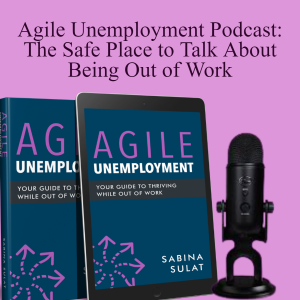
It shouldn’t be awkward and uncomfortable to talk about being unemployed. Given that sooner or later most of us will experience being out of work, shouldn’t we start to have normal and healthy conversations about being unemployed? Agile Unemployment podcast host, employment expert, and author, Sabina Sulat creates a safe place to talk about all things unemployment. In each episode, Sabina will cover everything you need to know to not only survive, but thrive through being out of work.









Agile Unemployment Podcast
Based on the book by the same name, the Agile Unemployment Podcast takes a deeper dive into all topics of unemployment. Join host and employment expert Sabina Sulat as she revolutionizes the way we think and talk about being out of work.
Episodes
Oct 8, 2026
Oct 8, 2026
29 min
Reality vs. the Fairy Tale: What Happens After Happily Ever After
The offer letter is the "happily ever after" of the job search. But the story doesn't end there.
In this episode of Agile Unemployment, Sabina Sulat looks at the part of job loss almost nobody talks about: what happens after you get the job. Returning to work is a logistical shift, and it's also an emotional, financial, and identity transition. It's often a nervous-system transition too. People walk in on Day One carrying months of rejection, silence, and self-doubt, and then feel pressure to be immediately excellent, grateful, and indispensable.
Sabina also covers this week in work: September's weak jobs report, and the Medicaid and SNAP notices now arriving in mailboxes. If you or someone in your household gets either benefit, this segment is time-sensitive.
In this episode:
What September's jobs report means for job seekers: 29,000 jobs added, unemployment at 4.2%, and 1.9 million people who have been looking for six months or more
Why wage growth at its slowest since 2021 matters for people re-entering work
Medicaid work requirements starting January 1, 2027, and the $580-a-month income shortcut many notices bury
Expanded SNAP work rules, and why the transition back to work is exactly when people fall through the cracks
Why the public story of unemployment ends too early
How fear after a long search can make you smaller at a new job
Why the first ninety days are your evaluation period too
Five things re-entry asks of you: patience, discernment, boundaries, language, and agency
Why onboarding is a human re-entry point, and what employers can do about it
Timestamps (approx.):
00:00 Cold open: the Sunday night before Day One
01:00 Welcome
01:30 This Week in Work: the September jobs report
04:30 Medicaid and SNAP: open your mail
08:00 The story ends too early
14:00 The first ninety days are yours too
17:00 What re-entry asks of you
22:00 Re-entry and the employee experience
24:00 Closing
Resources mentioned:
BLS Employment Situation, September 2026
Georgetown CCF: what state Medicaid work requirement notices look like
Pew: how SNAP changes shift costs to states
If a Medicaid or SNAP notice confuses you, contact your local legal aid office or your state benefits line before the deadline.
Share this episode with someone starting a new role after job loss, or with anyone on Medicaid or SNAP who needs to know what's in that envelope.
Agile Unemployment is a Re: Working production. The news in this episode is current as of October 2026.
Sep 8, 2026
Sep 8, 2026
37 min
Episode Summary
Most pivots don't begin with a dramatic exit — they begin with friction. Something that used to work stops working the same way, and the instinct is to blame yourself instead of asking whether the strategy still matches the system. This episode breaks down how to read that friction, the five signs it might be time to explore a pivot, and the difference between pivoting with agency and reacting with panic. Sabina also shares, for the first time on the show, where her own pivot from Agile Unemployment toward the broader Re: Working work is taking her — and why she's headed back to school to build it.
What You'll Learn
Why a strategy can be successful and still become outdated — and why that isn't failure
How to tell the difference between friction that means refine and friction that means replace
The five early signs it might be time to pivot (energy-to-return ratio, environmental change, outgrown questions, mismatched narrative, shifting language)
Why pivoting and panicking are not the same thing — and what agency actually looks like in the gap between them
The two kinds of coherence every good pivot needs: internal (does it make sense to you) and external (does it make sense to the world)
What this framework means differently for job seekers, careers, and organizations
Key Moments
The old map problem — why job-search advice that made sense in a previous labor market is no longer sufficient, and why that's a systems issue, not a personal one
Friction as data — reframing friction as information to investigate rather than a verdict to accept
The five signs — a diagnostic for recognizing when a pivot may be worth exploring
Explore before you declare — why testing, talking, and small pilots beat a grand announcement
The two coherences — internal and external, and why a pivot needs both to hold
Quotes
"A strategy can be successful and still become outdated."
"Friction does not always mean stop. Sometimes friction means refine."
"Agency is not control. Control wants certainty before it moves."
"You are not abandoning who you were. You are integrating what you have learned."
"The old map may have brought you here. Honor that. But if the terrain has changed, you are allowed to draw a new one."
Discussion Questions for Listeners
Where in your own work or job search have you noticed friction that keeps repeating?
Has your language about your own value changed in the last year — and have you noticed it?
Is the pivot you're considering internally coherent, externally coherent, or both?
Connect
Subscribe to Agile Unemployment wherever you listen, and follow along with the Re: Working series for more on work literacy and agency.
Aug 31, 2026
Aug 31, 2026
24 min
Episode Summary
When the news came of Dolly Parton's passing, the tributes wrote themselves — genius, generous, belonged to everyone. All true, and all said already. This episode goes somewhere else: into what she and 9 to 5 actually built, and why a comedy from 1980 still diagnoses the modern workplace more accurately than most of today's employee-experience language does.
In This Episode
What she actually pulled off — how a toe-tapping, singable melody turned workplace exhaustion into an anthem of challenge instead of bitterness, and how the film earned its own weight independent of the song
Agency vs. control — why agency is the smaller, more useful concept, and the one most "future of work" conversations skip past
The vocabulary problem — how organizations learned to say employee experience, psychological safety, and flexibility without actually moving any power
The bad boss was never the whole story — why removing one terrible manager doesn't fix the structure that protected him
Voice is not agency — the difference between being heard and actually changing anything
What answering the cry would require — treating worker knowledge as intelligence, not complaint
Why it was her — the craft underneath the charm, and why the argument under the song and the film still holds
Key Lines
"Agency is not control. Control means dictating the outcome, and almost nobody has that."
"It's not describing a workplace we've outgrown. It's describing one we've rebranded."
"Voice without response isn't agency. It's venting into a system that absorbs it and changes nothing."
"The workplace we haven't fixed isn't just the one with the terrible boss. It's the one with the structure that makes terrible bosses survivable."
"Who is still expected to keep showing up, keep smiling, keep producing, and keep absorbing the cost of systems they did not design?"
Frameworks Referenced
Agency — the ability to act with intention inside systems you don't fully control
Voice vs. Agency — the distinction between being able to speak and actually having influence
Closing Thought
Dolly Parton gave the question a tune. The question now is whether we're finally willing to hear what workers have been singing all along.
Credits
Thank you for listening to Agile Unemployment. And thank you, Dolly, for giving so many people words, music, humor, and courage for a truth they already knew.
Aug 23, 2026
Aug 23, 2026
31 min
Four years into Agile Unemployment, the core of unemployment hasn't changed — the emotion, the objective. But the terrain underneath has shifted materially, and most job seekers are still navigating with an old map. This episode breaks down what's changed, why organizational indecision (not candidate quality) is stalling so many searches, why chasing the algorithm backfires, and what actually works now.
Key Talking Points
Reflecting on 4 years of the show; what's stayed the same vs. what's changed; Marshall Goldsmith's What Got You Here Won't Get You There
What used to work — the old, linear hiring map and why its core assumptions no longer hold
What doesn't work the same way anymore — and the real culprit behind most "silence": organizational indecision, not candidate quality
Why we've never actually taught people how to find work — the case for work literacy
The algorithm trap — rage against the machine vs. join the bots, and why both lose
The PowerPoint story — a personal example of making your thinking visible when the formal process stalls
What works now — networking, redefined (not favors, relationship and visibility)
Strategy as the new survival skill
The new map — résumé, LinkedIn, AI, applications, patience, confidence, agency, reassembled
Quotes:
"You may not be failing. You may be using an old map."
"Sometimes the organization simply hasn't figured out what it's doing yet — and you got caught inside that."
"Hiring was never supposed to become two algorithms talking past each other while the people on both ends disappear."
"If the problem is the map, you can change the map."
Aug 16, 2026
Aug 16, 2026
55 min
On the show's fourth anniversary, Sabina steps out from behind the guest chair to trace how a podcast about unemployment became a body of work about agency — and to lay out where work is headed next: for individuals, for Gen Z, for the résumé, and for the world beyond the U.S.
Episode Description
Four years ago, Agile Unemployment started as a place to say a word most people wouldn't say out loud. One hundred episodes, more than thirty guest interviews, and listeners in over 70 countries later, it's become something bigger: a running argument about what work actually is, what it owes us, and what we owe ourselves inside it.
In this special solo anniversary episode, Sabina looks back at the story that changed how she thinks about the show, unpacks why "the system changed and no one sent the memo" became the throughline of everything that followed, and makes the case for why the next decade of work will be won by agency, not credentials. She also gets specific about what's coming: why Gen Z's pushback is signal, not entitlement; why AI is exposing the résumé's oldest flaw rather than killing it outright; and why none of this — despite where the show started — is a uniquely American story.
What's Covered
The anniversary numbers: 100 episodes, 30+ interviews, tens of thousands of downloads, listeners in 70+ countries
How the show evolved from tactical job-search advice into a framework for work literacy and agency
Why unemployment is a phase in the employee experience cycle, not an exception to it
Command vs. control — and why the distinction matters most when you have the least certainty
Why this is a global story, not a U.S. one
What Gen Z is actually asking for, and why the workplace should listen
The real reason the résumé is breaking down — and what's replacing it
Where Sabina's own work is headed next
Quotes
"They were handed a map. Nobody told them the terrain had already changed underneath it."
"Entitlement is the easy read. It is also the wrong one."
"The timeline is theirs. Your response is yours. That is command."
Thank You
To every guest, every listener, and everyone who's ever hit play on an episode about unemployment instead of scrolling past it — thank you for four years.
Aug 13, 2026
Aug 13, 2026
21 min
Episode Summary
Everyone braces for rejection in a job search. Almost no one braces for silence — or for a yes. In this episode, Sabina breaks down the two moments in a job search that quietly cost people their agency: the wait between applying and hearing back, and the offer itself. She makes the case that the first boundaries of a new job aren't set on Day One — they're set in unemployment, long before an offer ever arrives.
What You'll Learn
Why the waiting period is never neutral — and what it's doing to you if you don't have a plan for it
The difference between structure and control, and why only one of them actually protects you
How relief, fatigue, and financial pressure can turn a job offer into something that overrides your judgment
Specific language for holding your ground when an offer arrives ("I'd like to review the full offer," "What does success look like in the first 90 days?")
Why the first boundaries of a new job are set during the hiring process — not after it
What giving up agency actually looks like (hint: it's not always passivity — sometimes it's frantic motion)
What retaining agency looks like, and how it changes the way you enter your next role
Key Quote
"The timeline is theirs. But your response is yours."
Segments
The Wait Needs a Plan — Why unstructured waiting lets someone else's response time run your emotional life
The Offer Needs a Plan Too — Why the offer is a decision point, not a rescue
The First Boundaries Are Set Before Day One — How your hiring-process patterns become your employee patterns
What Giving Up Agency Looks Like
What Retaining Agency Looks Like
Closing: Command Before the Offer
Listener Challenge
Before your next follow-up email, decide — in advance — what you'll do if the answer is silence, no, or yes. Write it down. That's your plan for the wait and the offer, before either one arrives.
Connect
Agile Unemployment — available wherever you listen. Find Sabina Sulat and Re: Working at [re-working.com].
Aug 5, 2026
Aug 5, 2026
32 min
Rerouting the Noise: How to Begin to Function in Unemployment
Runtime: ~30 minutes
Episode Description
Functioning is not the same as command. You can be answering every email, showing up to every meeting, applying to every job — and still be managing your life instead of leading it. This episode breaks down why capable people lose command without noticing, and what it actually takes to get it back.
Plus: a read on where the labor market really stands right now — including why "harder" is the wrong word for what's happening, and what's actually changed underneath the process. And a first for the show: Japan has overtaken the U.S. as our top listening audience this month. We want to hear from you.
In This Episode
The June jobs numbers, and why a falling unemployment rate isn't the good news it looks like
Why the job search isn't just harder — it's running on a different process than the one most people's expectations were built for
The difference between control and command
How capable people mistake functioning for leading
Movement vs. direction — and why busy isn't the same as unstuck
What happens when urgency becomes your operating system
Open loops: why unfinished small things steal disproportionate attention
Why shame is not a leadership strategy
Rest as a command decision, not a reward
Applying all of it to job search and career transition
The difference between perfectionism and standards
One question to carry into your week
Key Takeaways
A falling unemployment rate isn't automatically good news — check whether it's coming from more hiring or fewer people in the labor force.
The job search process has changed structurally (application volume, channel effectiveness, timelines). Measuring yourself against an outdated version of the process turns a systems problem into a self-worth problem.
Functioning (still moving, still doing) is not the same as command (leading with clarity and intention).
Command is restored in small, often quiet moves — not dramatic overhauls.
Call to Action
For the first time since this podcast launched, Japan is our top listening country this month. If that's you, we'd love to hear from you. What brought you to the show, and what's resonating? Reach out or leave a review; help us understand this audience, not just count it.
Discussion / Reflection Prompt
Where am I functioning, but not leading?
Jul 29, 2026
Jul 29, 2026
42 min
There are seasons when life does not fall apart exactly.
It just gets loud.
Too many open loops. Too many deferred decisions. Too many responsibilities waiting for attention. Too many emails, appointments, projects, rooms, conversations, worries, and future plans quietly asking to be handled.
At some point, the issue is not that you are incapable.
The issue is that you are no longer leading your life.
You are responding to it.
In this episode of Agile Unemployment, Sabina explores the idea of Restoring Command: the process of returning to calm authority over your life when work, health, home, money, relationships, and future plans begin to feel scattered.
This is not about control. Control is often fear dressed up as discipline. It tightens, grasps, and tries to eliminate uncertainty.
Command is different.
Command is the ability to look honestly at the real state of things and say: this is where I am, this is what matters, this is what needs support, and this is the next responsible move.
This episode is for anyone who is still functioning, still showing up, still getting things done — but quietly knows they are reacting more than leading.
Sabina discusses why capable people are especially vulnerable to losing command, how urgency and open loops drain agency, why shame is a terrible strategy, and why rest is sometimes the first act of leadership.
She also connects Restoring Command to career transition and unemployment, where the loss of work can disrupt not only income, but identity, structure, confidence, health, relationships, and future plans.
Because getting back to work is not only about activity.
It is about traction.
And traction begins when you restore enough command to choose the next responsible move.
In This Episode
Sabina explores:
The difference between control and command
Why functioning is not the same as leading
How capable people can become trapped by their own capacity
Why urgency is not always importance
The emotional cost of open loops
How shame weakens agency instead of restoring it
Why rest can be a command decision
What restoring command looks like during unemployment or career transition
How to move from activity to traction
Why the next responsible move matters more than the perfect plan
Pull Quotes
“Functioning means you are still moving. Command means you are leading.”
“Control is often fear dressed up as discipline. Command is calm authority.”
“Shame is not a strategy.”
“Rest is not quitting. Rest is returning to capacity.”
“Activity burns energy. Traction restores agency.”
“You do not have to fix everything today. You do have to return to yourself.”
“Command is not the absence of uncertainty. Command is the ability to lead yourself inside uncertainty.”
Listener Reflection Questions
Where am I functioning, but not leading?
What open loop is taking up more energy than it deserves?
What am I avoiding because it feels too big, too late, or too emotionally expensive?
Where has urgency been making decisions for me?
What would restore even a small amount of command this week?
What is the next responsible move?
Suggested Episode Description
When life gets loud, it is easy to confuse functioning with command. You may still be answering emails, showing up to meetings, caring for others, applying for jobs, managing the house, and keeping things moving — while quietly knowing that you are reacting more than leading.
In this episode, Sabina Sulat explores what it means to restore command: not control, not perfection, and not panic disguised as productivity, but calm authority over your attention, energy, standards, and next moves.
This episode is about open loops, urgency, shame, rest, career transition, unemployment, and the power of choosing the next responsible move.
Jun 30, 2026
Jun 30, 2026
28 min
Regaining Traction Without Blaming Yourself: From Shame to Agency
There is a difference between failing and being overwhelmed.
There is a difference between self-sabotage and survival.
And there is a difference between losing traction and losing your future.
In this episode, Sabina talks about what happens when someone is operating under prolonged threat while still trying to build a future.
A hard chapter does not just affect your circumstances. Over time, it can affect how you interpret yourself.
At first, you may be able to say:
“I lost my job.”“I am dealing with a financial issue.”“I am burned out.”“I am in transition.”
But when stress continues, the language often changes.
“What is wrong with me?”“Why can’t I fix this?”“Why am I so far behind?”“Why am I frozen?”“Why can everyone else manage their lives and I cannot?”
That is where shame takes over.
Shame takes a situation and turns it into an identity. A hard chapter becomes a failed life. A delay becomes proof that you are irresponsible. A period of freezing becomes evidence that you are broken.
But many people are not broken.
They are overloaded.
They may be trying to solve complicated problems while sleep-deprived, scared, isolated, financially strained, emotionally exhausted, and unsure of who or what to trust.
This episode explores why people do not do their best long-term strategic thinking while they feel under threat—and why that word, feel, matters.
The future gets harder to imagine. Small tasks feel enormous. Decisions feel dangerous. Phone calls feel impossible. Opening mail can feel threatening. Answering messages can feel like climbing a mountain.
Then the spiral begins: a person cannot operate at their usual capacity, judges themselves for that loss of capacity, and carries shame on top of the stress that caused it.
Sabina offers a practical framework for rebuilding agency:
Containment
What must be stabilized first?
Containment is not solving everything. It is addressing the issue that is most urgent, most destabilizing, or most within reach. It may be opening one piece of mail, making one appointment, getting one night of sleep, calling one person, or resolving the problem that is screaming the loudest.
You cannot fix everything at once. But you can decide what comes first.
Sequencing
What comes next—and what has to wait?
Sequencing restores order when everything feels urgent.
First facts. Then options. Then decisions. Then action.
Or:
First stabilize. Then prioritize. Then move.
Not every important thing is first. Sometimes the most powerful thing a person can hear is, “Not today.” Not because it does not matter, but because it is not first.
Support
Who needs to be in this with me?
Support is not weakness. It is infrastructure.
The more complex the situation, the more support matters—not because you are incapable, but because complexity requires structure.
Support may be an attorney, therapist, doctor, financial advisor, coach, mentor, friend, colleague, family member, community, or someone who can simply sit beside you while you make the call.
Agency does not usually return through shame.
It returns through clarity, structure, information, support, and the next doable action.
This episode is for anyone who has been carrying too much for too long—and for the people, employers, educators, leaders, and communities who want to understand what support can look like before someone reaches a breaking point.
A hard chapter is not the whole book.
You may have lost traction.
That is not the same thing as losing your future.
In This Episode
Why prolonged stress changes how we see ourselves
How shame turns circumstances into identity
Why cumulative pressure can be as destabilizing as a single crisis
Why people under threat may avoid, freeze, delay, or struggle to advocate for themselves
The difference between responsibility and blame
How containment, sequencing, and support help rebuild agency
Why support is infrastructure, not weakness
How to create a future that is both beautiful and structurally possible
Key Quotes
“Shame takes a situation and turns it into an identity.”
“You stop seeing a crisis that needs containment, sequencing, and support. You see yourself as the crisis.”
“You cannot fix everything at once. But you can decide what comes first.”
“Not every important thing is first.”
“Support is not weakness. It is infrastructure.”
“The more complex the situation, the more support matters—not because you are incapable, but because complexity requires structure.”
“Agency does not usually return through shame. Agency returns through clarity, structure, information, support, and the next doable action.”
“You may have lost traction. That is not the same thing as losing your future.”
Reflection Questions
What in my life feels most urgent right now?
What actually needs containment first?
What information do I need before I make a decision?
What is important but not for today?
Who needs to be in this with me?
What is one next doable action that would create even a little more stability?
Jun 10, 2026
Jun 10, 2026
27 min
Episode Description
In this episode of Agile Unemployment, Sabina Sulat examines the workplace term “insubordination” and why it often operates less like a clear behavior and more like a subjective label. Prompted by recent public commentary around Scott Pelley’s departure from CBS (while acknowledging we don’t know what happened inside the room), Sabina explores how “insubordination” can be used to control narratives in organizations that claim to value ethics and a speak-up culture. We unpack the speak-up paradox, the link between insubordination and psychological safety, the culture damage caused by misuse of the label, and practical options for speaking up with strategy and agency—plus how to talk about it in interviews if you’ve been tagged with the word.
What We Cover
Why this topic is back in the public conversation (and what we can and can’t know)
“Insubordination” on paper vs. how it’s used in real workplaces
The 3 things people confuse: principled dissent, interpersonal breakdown, and power/control
Psychological safety and the role of standing up for others
The “speak up” paradox: encouraged to speak until you do
What kind of culture forms when “insubordination” becomes a catch-all label
How misuse drives toxicity, fear, low insight, and low creativity
Why the threat of “insubordination” often signals a failure of management and coaching
What to do: options for speaking up with strategy (channel, framing, documentation, allies)
When leaving is the most adult expression of agency
Interviewing after a conflict: a clean narrative structure you can use
Key Takeaways
Insubordination is often less about what was said than what it threatened.
A true speak-up culture requires governance, not slogans.
Psychological safety isn’t comfort; it’s the ability to raise truth without retaliation.
You can be principled and strategic: choose channel, frame in outcomes, document cleanly.
If a culture punishes truth, you have options—and exiting isn’t failure.
Practical Framework: “How to Speak Up Without Self-Sabotage”
Try these options depending on your environment:
Clarify the directive and success metric
Separate facts, impact, recommendation, and what you need
Choose the smallest effective audience first
Document for clarity (not paranoia)
Anchor to values and risk (fairness, compliance, customer impact)
Build allies/sponsorship when the culture is political
Know your line (preference vs integrity)
Know when the cost is too high and plan a dignified exit
Quote Pulls for Social
“Discomfort gets mislabeled as misconduct.”
“If you punish truth, you get silence. Silence becomes surprise. Surprise becomes crisis.”
“Psychological safety isn’t comfort. It’s truth without retaliation.”
“A label is not a verdict. Learn the system, then choose your move.”
“Leaving isn’t failure. Sometimes leaving is agency.”
Related Listening
Sabina references the work of Jocelyn Davis and her book Insubordinate and encourages listeners to revisit prior episodes featuring Jocelyn for another lens on the fine line between being “insubordinate” and being principled.
Hashtags / Tags
#AgileUnemployment #WorkLiteracy #Agency #SpeakUpCulture #Leadership #PsychologicalSafety #CareerTransitions